Greek mythology is a vast tapestry of gods, heroes, and mythical beings, among which the Titans hold a prominent place. These ancient deities embody the primordial forces of the cosmos and play a pivotal role in the mythological narratives that shaped ancient Greek culture. This article delves deep into the world of Titans, exploring their origins, characteristics, stories, and influence on mythology and culture.
Origins of the Titans
The Titans are often described as the offspring of Gaia (Earth) and Uranus (Sky). In Hesiod’s Theogony, which serves as a fundamental resource on Greek mythology, the lineage of the Titans is detailed. According to this text, the first generation of Titans includes twelve primary Titans:
- Cronus (Kronos) – The leader of the Titans, often associated with time and the harvest.
- Rhea – Sister and wife of Cronus, mother of the Olympian gods.
- Oceanus – The personification of the ocean, representing the vast water bodies.
- Tethys – Sister of Oceanus; goddess of the nourishing flow of water.
- Hyperion – The Titan of light and observation, father of Helios (Sun), Selene (Moon), and Eos (Dawn).
- Theia – Sister of Hyperion and goddess of sight and the shining light of the clear blue sky.
- Coeus – The Titan of intellect and the axis of heaven.
- Phoebe – Sister of Coeus and associated with prophecy and the Moon.
- Crius – The god of constellations, associated with strength and virility.
- Iapetus – The Titan associated with mortality and craftsmanship, father of Prometheus, Epimetheus, and Atlas.
- Mnemosyne – The goddess of memory and mother of the Muses.
- Themis – The embodiment of divine order, law, and custom.
The Titanomachy
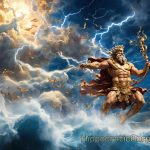
The most significant event involving the Titans is known as the Titanomachy, the epic battle between the Titans and the Olympian gods, led by Zeus. This conflict arose when Cronus, fearing that his children would overthrow him as he had done to Uranus, swallowed each of them at birth. Rhea, in defiance, saved her youngest child, Zeus, by hiding him away in Crete. Upon reaching adulthood, Zeus returned to rescue his siblings and confront Cronus.
The war lasted for ten years and was characterized by immense conflict and cosmic battles. Ultimately, the Olympians emerged victorious, leading to the imprisonment of the Titans in Tartarus, a deep abyss used as a dungeon of torment and suffering.
Characteristics and Symbols
The Titans are often portrayed as embodiments of elemental and cosmic forces. Each Titan has their own unique attributes and domains:
- Cronus is often depicted with a sickle or scythe, symbolizing harvest and the passage of time.
- Rhea is commonly represented with the Rock of Zeus, signifying her role in protecting her son.
- Oceanus is shown encircled by waves, embodying the seas and rivers.
- Hyperion and Theia are associated with light, often depicted alongside celestial elements.
- Iapetus conveys craftsmanship, reflected in his associations with humanity, particularly through his sons Prometheus and Epimetheus, who played pivotal roles in the creation of mankind and the subsequent myths.
Prominent Titans in Mythology
In addition to the original twelve, several Titans have left a more significant mark within mythology:
- Prometheus – The Titan who defied Zeus by stealing fire from the gods and giving it to humanity. For his transgression, he was punished and bound to a rock where an eagle would eat his liver daily, only for it to regenerate overnight.
- Atlas – Known for holding up the heavens, Atlas is often depicted with the globe, symbolizing endurance and strength. His punishment from Zeus was also a result of the Titanomachy, where he was cursed to bear the weight of the sky.
- Epimetheus – Known for his role in the myth of Pandora, he symbolizes hindsight and is seen as the counterpart to his brother Prometheus, who represents forethought.
The Titans’ Legacy
The legacy of the Titans extends beyond their mythological narratives. They represent chaos and the disordered primordial state of the universe, in contrast to the ordered and civilized society represented by the Olympian gods. This struggle between order and chaos, light and dark, is a recurring theme in various mythologies.
Cultural Interpretations
In modern literature, art, and popular culture, the Titans continue to inspire. They appear in various adaptations and reinterpretations, including works by authors like Rick Riordan, who integrates these figures into contemporary narratives for younger audiences.
Moreover, the Titans serve as an allegory for generational conflict and the cyclical nature of power, mirroring political landscapes and societal changes throughout history. Their mythos invites reflection on the themes of destiny, hubris, and the quest for knowledge that resonate with many contemporary issues.
Conclusion
The Titans are a vital part of Greek mythology, representing fundamental forces and complex themes that have captivated imaginations for centuries. Their stories illuminate the struggles between the old and the new, chaos and order, and the intrinsic nature of power. As symbols of endurance, knowledge, and the human experience, the Titans remain relevant in both historical context and modern interpretation, evoking an enduring fascination that continues to inspire storytelling across cultures.